7 Reasons Why 100,000+ People Over 50 Are Adding This 1,000-Year-Old Japanese Breakfast To Their Routine
Summary: In Japan, a bowl of natto (fermented soybeans) has been a breakfast staple for over 1,000 years, and scientists have spent decades studying the two nutrients that make it unique: the enzyme nattokinase and vitamin K2. Most Americans will never eat it. It's sticky, it smells, and it's an acquired taste. Here are 7 reasons more people over 50 are getting it in a different form.

1. “I Took Calcium For 20 Years. Nobody Told Me Where It Went.”
In the '80s and '90s, everyone over 40 heard the same advice: take your calcium. Millions did, for decades.
What almost nobody mentioned is that calcium needs direction. Vitamin K2 works like a traffic cop: it activates proteins that help guide calcium into your bones and away from places it doesn't belong, like your arteries.*
Natto is the richest food source of K2 on earth, with roughly 700 µg per 100 g, about 100 times more than unfermented soybeans. The fermentation is what creates it.

2. “My Hands Were Always Cold”
Socks to bed, even in summer. A blanket on your lap at 2pm. Hands so cold the grandkids flinch. Your fingers and toes sit at the very end of your circulation, so they’re the first place you feel it when blood flow gets sluggish. Most people over 55 just call it “getting older.”
In 1980, Japanese researcher Dr. Hiroyuki Sumi was studying how the body breaks down fibrin, a protein involved in blood clotting. He tested 173 different foods. The one that stood out was natto, and the enzyme he found inside it was named nattokinase.
Today, nattokinase is one of the most studied natural enzymes for supporting healthy blood flow and circulation.*

3. The Parts Of Japan That Eat The Most Natto Have Something In Common
Researchers measured blood levels of vitamin K2 (MK-7) in women in three places. In Tokyo, where natto is eaten often, the average was 5.26 ng/mL. In Hiroshima, where natto is less popular, it was 1.22. In Britain, just 0.37.
The same team found that across Japan's prefectures, higher natto consumption went hand in hand with lower hip fracture rates. A separate study of Japanese women after menopause found that those who ate 4 or more packs of natto a week lost less bone density over time.
These are studies of natto as a food, not of any supplement. But they're a big part of why so many people want what's in natto every day.*

4. “The Supplement Aisle Was Lying To Me”
When ConsumerLab, an independent testing company, tested nattokinase supplements, only 5 of 8 delivered the enzyme activity (FU) listed on the label.
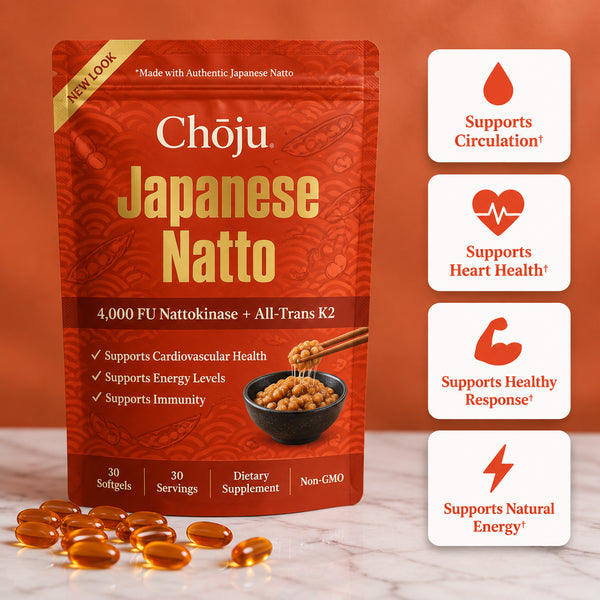
Nattokinase is an enzyme, and enzymes are fragile. Heat, air and moisture wear them down, yet most nattokinase is sold as a dry powder in a capsule. Chōju is sealed in MCT oil inside a softgel. If you tried nattokinase before and felt nothing, it might not have been you. It might have been the capsule.
Chōju is made with authentic Japanese natto, and every batch is checked by an independent lab for enzyme activity, so the 4,000 FU on the bag is what's in the softgel.

5. “I Was Already Taking 9 Pills”
By 50, a lot of us have a pill organizer that looks like a tackle box. Something for the heart, something for the bones, something else for the gut.
Natto naturally brings nattokinase and vitamin K2 together in one traditional fermented food.
Chōju puts 4,000 FU nattokinase, vitamin K2, vitamin D3 and vitamin B12 in one small softgel. That's four bottles' worth in one, once a day.

6. “Why I Don't Eat The Real Thing”
Let's be honest: real natto is an acquired taste. It smells strong, it's sticky and stringy, and most Americans can't get past the first bite.
Even in Japan, many modern natto brands have been made milder to suit today's tastes, and according to Dr. Sumi, milder natto can mean less of the K2 and nattokinase that made it famous.
Chōju gives you what made Japan's traditional breakfast famous in one small softgel. No smell, no slime, no chopsticks.

7. Feeling Good Enough To Keep Doing What You Love
Getting down on the floor with the grandkids. A full morning in the garden. Staying in your own home, on your own terms. That's what most people over 50 really want to protect.
A daily ritual from one of the world's longest-lived cultures is a simple place to start: one softgel with breakfast, every morning.*
One honest note: nattokinase and vitamin K2 both matter if you take warfarin, Eliquis or any blood thinner, or have surgery planned. Talk to your doctor before you start. Chōju also contains soy (natto is fermented soybeans). We'd rather you ask.
What's In Every Softgel
4,000 FU nattokinase from Japanese natto · 180 mcg vitamin K2 (MK-7) · 2,000 IU vitamin D3 · 500 mcg vitamin B12. Sealed in MCT oil inside a softgel, not a dry powder. Every batch checked by an independent lab. 30 softgels, one a day with breakfast. Contains soy.
What if I don't notice anything? Some people notice a difference and some don't. That's why you get 120 days. Take it daily, and if it doesn't earn its place in your morning, email us for a full refund. No need to send anything back.
Buy 2, Get 1 FREE